
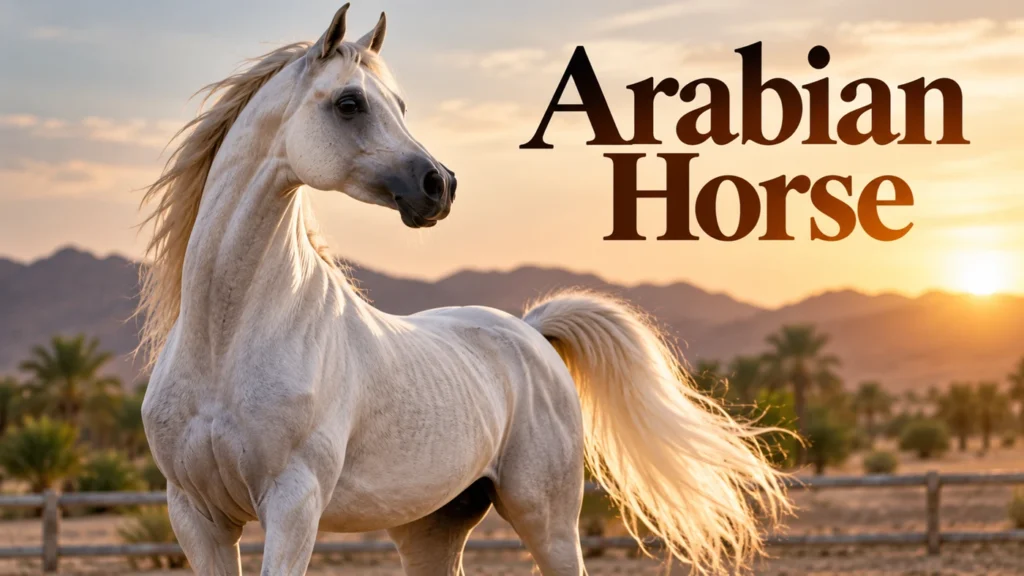
The Arabian Horse is one of the most recognizable and historically significant horse breeds in the world. Because of its elegant look, endurance, intelligence, and characteristic high tail carriage, it has always been linked with the desert areas of the Middle East. For many centuries, the breed has developed together with Bedouin tribes and was appreciated for its ability to cover long distances without losing strength, agility, or responsiveness.
Arabian horses are now to be found all over the world and take part in a wide variety of equestrian activities. They have become popular with riders, breeders, and horse lovers because of their stamina, athleticism, and versatility.
History and the Origin of the Arabian Horse
The precise origins of the Arabian horse are still the subject of historical debate. The breed, nevertheless, has always been linked with the Middle East and with the desert cultures of the Arabian Peninsula for many centuries.
Bedouin horse breeders played an important role in developing and preserving Arabian bloodlines. In demanding desert environments, horses needed to be hardy, efficient, and able to travel long distances. Breeding practices therefore placed importance on qualities such as stamina, soundness, speed, and temperament.
Because of trade, war, and the exchange of breeding stock, the Arabian horse slowly spread its influence beyond the Middle East; in Europe, in particular, its impact was noticeable since Arabian blood contributed to the development and improvement of a number of other horse breeds, and the degree of the breed’s influence is especially clear when one looks at the history of the thoroughbred.
Physical Characteristics of Arabian Horse
Arabian horses have a distinctive appearance that makes them easy to recognize. Their head is relatively small and finely shaped, often featuring a characteristic concave or ‘dished’ facial profile. They generally have large, expressive eyes, small ears, and large nostrils. Other notable features include a long arched neck, a relatively short back, a deep chest, and strong legs. Another characteristic feature is their naturally tall carriage, which contributes to their elegant appearance in motion.
Although Arabs are usually lighter in frame than heavier horse breeds, their look should not be taken to mean that they are weak. In fact, their bodies are built for efficiency, for movement, and for endurance, which enables them to travel over long distances.
Arabian Horse Temperament
Arabian horses are often recognized for their intelligence, sensitivity, and willingness to interact with people. Their long history of close association with humans contributed to a breed known for responsiveness and a strong human-horse relationship.
However, individual temperament can vary between horses. Training, handling, breeding, and the environment in which a horse is raised can all influence its behavior.
Because Arabians can be sensitive and attentive to their surroundings, consistent training and calm handling are important when working with them.
Endurance and Athletic Ability
Endurance is one of the most well-known features of the Arabian horse, and the breed’s historical development in difficult environments led to the creation of horses that are capable of traveling long distances while retaining their stamina.
This ability has made Arabians particularly successful in endurance riding. They can also compete in disciplines such as dressage, jumping, racing, trail riding, and various English and Western events.
Because of their versatility, Arabian horses are not confined to a single kind of equestrian activity; they can take part in competitions as well as have some recreational riding.
Arabian Horses and Their Influence on Other Breeds
The Arabian horse has been important in the development of other horse breeds, since Arabian blood was included in breeding programs in various parts of Europe and elsewhere, contributing traits like endurance, refinement, and athletic ability.
Arabian influence is particularly associated with the development of the thoroughbred. Arabian horses and other Middle Eastern stallions were important to early Thoroughbred breeding in England. Arabian blood has also influenced various other light horse breeds around the world.
Common Colours of Arabian Horses
Arabian horses can occur in several colors and markings, though some are more common in particular bloodlines.
The grey coat is particularly noticeable among Arabian horses and can become progressively lighter as the horse ages.
Uses of Arabian Horses
Arabian horses are used for a variety of purposes today. Some of the most common include:
- Endurance Riding
- Competitive Trail Riding
- Horse Shows
- Dressage
- Racing
- Recreational Riding
- Breeding Programs
- England and Western Disciplines
Their combination of stamina, trainability, and athleticism allows them to adapt to different activities.
Arabian Horse Care
Like all horses, Arabian horses require appropriate nutrition, clean water, regular exercise, grooming, and veterinary care. Their diet should be adjusted according to factors such as age, workload, body condition, and overall health. Regular hoof care is also important because hooves are essential for movement and performance. Grooming helps maintain the coat and provides an opportunity to check the horse for injuries, skin problems, or other abnormalities.
Training must take into account the age, experience, and temperament of the individual horse, and a method that is balanced by incorporating exercise, rest, and proper nutrition can help to promote the horse’s general well-being.
Why is the Arabian Horse So Popular?
The Arabian horse combines an unusual range of qualities. Its elegant appearance makes it popular in shows and breeding programs, while its stamina and athletic ability have made it valuable in endurance and other equestrian sports.
The fact that it has a long history and has influenced other horse breeds also adds to its cultural and historical significance. At present, Arabian horses are still attracting people not only on account of their look but also because of their versatility and the close relationship they have with humans.
FAQs about Arabian Horse
The Arabian horse is a remarkable combination of history, beauty, and athletic ability; it has been the result of centuries of selective breeding in the Middle East and is known for its endurance, soundness, intelligence, and agility.
Arabian horses have continued to show their versatility in long-distance endurance races, in recreational riding and in breeding programs. The effect of the Arabian horse on other breeds of horse and its lasting link with human history have helped to establish it as one of the most important horse breeds in the world.